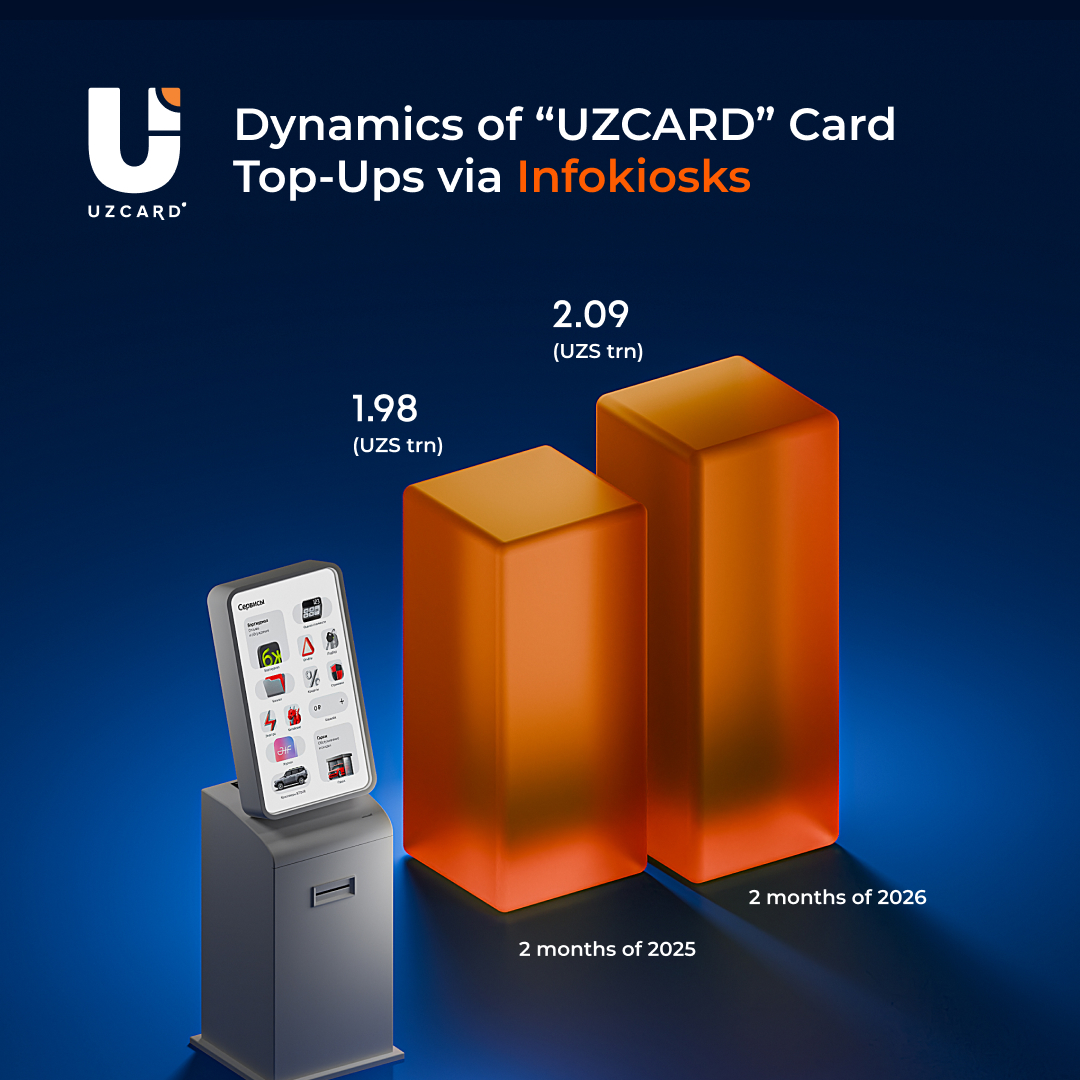
Infokiosks play a key role in the country’s payment infrastructure and are widely used by the population for everyday payments, including mobile phone services, utilities, government services, and fines. Their importance is especially notable among users who do not use mobile banking applications and prefer cash transactions, including topping up bank cards (cash-in).
Currently, more than 20,000 infokiosks are connected to the «UZCARD» payment system, with the majority serviced by payment organizations. The highest concentration of infokiosks is in the capital city and regional centers, where bank cards are topped up with cash through EPOS terminals.
In the first two months of 2026, the total volume of «UZCARD» card top-ups via infokiosks reached UZS 2 trln, a 5% increase compared to the same period last year.
The main player in this segment is «Paynet», accounting for 94% of the turnover of infokiosks connected to the «UZCARD» system. However, this share has slightly decreased compared to the first two months of 2025. This shift was influenced by a 47% increase in turnover from «OSON». A similar positive trend was observed for «Ipak Yuli Bank», where top-ups via infokiosks grew by 5% compared to 2025.
At the same time, banks are increasingly focusing on cash-in ATMs and universal devices, which offer more functions and generate higher revenue compared to infokiosks.
A notable recent development is the entry of «Alif» into the infokiosk market, actively installing its devices at metro stations. In the first two months of 2026, the largest top-up volumes via these infokiosks were observed for «UZCARD» cards issued by the following banks: «Ipoteka bank (14%), Ipak Yuli Bank» (13%), «Xalq Banki» (12%), and «Milliy Bank» (12%).
Regarding «Paynet», the largest top-up volume was recorded for «Xalq Bank» cards, accounting for 19%. This figure, however, is 3% lower than last year. The change in structure was driven by increased top-ups to «Agrobank» cards, which reached nearly UZS 190 billion, a 38% increase over the previous year. A similar growth trend was observed for «Ipak Yuli Bank», with a share of 10%.
Additional information: According to international experience, infokiosks can effectively improve financial inclusion, promote cashless payments, and integrate the population into the digital financial system. They act as a bridge between the cash and digital economies and are a key tool for a managed transition to cashless payments.
To expand the number of points where cash can be converted into digital form, payment systems actively support the development of this segment through technological, financial, and infrastructure assistance.